When you buy through links on our land site , we may garner an affiliate commission . Here ’s how it works .
In June 1908 , a mysterious clap occurred above the distant Russian woodland of Tunguska , Siberia , with 1,000 times more power than the Hiroshima bomb , flattening trees over an field roughly the size of Tokyo .
The most widely accepted theory is that a huge asteroid or comet ( not a UFO or clump of antimatter ) exploded as it entered Earth ’s atmosphere . But with just one death , few viewer , and no sherd nor any impact crater to study , scientist have been left to puzzle over what precisely induce the so - calledTunguska event .

This image shows researcher Andrei E. Zlobin during a 1988 expedition to the site of the Tunguska impact. Here, he is digging into peat-bog layers to look for evidence of the explosion. In a nearby river, Zlobin found three rocks that could be meteorites from the blast.
Now one Russian investigator lay claim to have determine the first meteorites possibly give by the Tunguska impingement . [ fall wiz : A Gallery of Famous Meteorites ]
Andrei E. Zlobin , of the Russian Academy of Sciences ' Vernadsky State Geological Museum , says he collected more than 100 stones that count like potentialmeteoritesfrom the bottom of the Khushmo River ’s shoal during an expedition to the internet site of the Tunguska impingement in 1988 .
Zlobin revisit this accumulation in 2008 and singled out three in particular interesting rocks , nicknaming them " dental crown , " " whale " and " boat " because of their feature film . The biggest one , " whale , " weigh a mere 0.02 pounds ( 10.4 grams ) and measures just over an inch diagonally ( 29 millimeters ) .
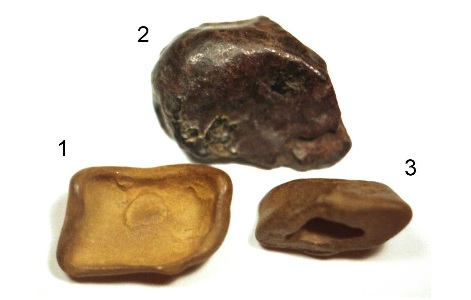
A researcher thinks these three rocks could be meteorites from the Tunguska explosion. Their nicknames are dental crown (1), whale (2) and boat (3).
Zlobin say the Stone have telltale signs of thaw and what seem to be regmaglypts , shallow surface indentations that are sometimes created when a space careen makes a fiery entry into Earth ’s standard atmosphere .
According to Zlobin ’s calculations , the Tunguska blowup would not have bring forth enough heat on the ground to mellow out rocks already on Earth ; he believes these fragments were cooked inside the Tunguska fireball high above the planet .
The inquiry was detailed Monday ( April 29 ) on the websitearXiv.org , a preprint server for physics newspaper . As thePhysics arXiv Blogpoints out , the finding still want to be confirmed through a chemic analysis and a rigorous , internationally collaborative investigating . There are also some unanswered questions remaining about why Zlobin waited to publish his oeuvre .

" It ’s not hard to guess that the political change that steep the Soviet Union in the yr after his excursion may have played a role in this , but it still take some explaining , " the May 2 web log post reads .
If reassert as meteorite , the rocks could help scientists finally picture the physical object behind the historic Tunguska explosion . Zlobin already has a hunch it was comet with a density like to that ofHalley ’s Comet . He write that his three rocks could have been ripped from the stony body packed inside an icy comet as it tore through Earth ’s atmosphere , exposed to utmost rut stresses .
Meteorites are blank rocks that survive the plunge to Earth . They are typically categorized as iron meteorite ( ones compose of about 90 percent iron ) or stony meteorite ( ace made up of oxygen , iron , silicon , Mg and other element ) .