When you purchase through link on our internet site , we may earn an affiliate charge . Here ’s how it put to work .
scientist have spent 10 contemplate the extraordinary ability and anatomy of human sperm , so an international team of researchers was surprised to bring out a mysterious , helical - shaped nanostructure in the tails of sperm cell .
The newfound whorl may give sperm tail a cost increase , the scientist said .

Researchers have uncovered a previously unknown spiral-shaped nanostructure in human sperm tails.
Sperm need a extremely effective tail so they can swim as fast as potential toward the testicle and attempt to fertilise it . Each spermatozoan tail has thousands of building blocks , the most crucial of which are called tubulins , the researchers said . These tubulins mold foresightful thermionic tube known as microtubules in the sperm ’s prat . [ Sexy natator : 7 fact About Sperm ]
These microtubule are attached to thousands of motor proteins ( proteins that can move ) that pull and bend the microtubules , earmark the sperm to drown .
" It ’s actually quite unbelievable that it can work , " analyse older researcher Johanna Höög , a researcher in the Department of Chemistry and Molecular Biology at the University of Gothenburg , in Sweden , enounce in a statement . " The movement of thousands of motor proteins has to be coordinated in the minutest of detail in society for the sperm to be able to swim . "

Researchers have uncovered a previously unknown spiral-shaped nanostructure in human sperm tails.
To get a unspoilt looking at at the spermatozoon butt , Höög and her co-worker visualize sperm cell specimens with aNobel Prize - win microscope techniqueknown as cryo - electron tomography , or cryo - ET . This method acting allows researchers to freeze flyspeck structures , such as sperm , and take a series of 2D pictures that can then be merge to make an incredibly detailed 3D image . Moreover , this method acting does n’t command any chemicals , which would mist the smallest cell structures , Höög said .
" When we looked at the first 3D range of a function of the very end section ofa sperm tail , we distinguish something we had never seen before inside the microtubules : [ a ] spiral that stretched in from the pourboire of the sperm and was about a tenth of the length of the nates , " Höög said .
The researchers name the helical structure a " tail axoneme intra - lumenal spiral , " or TAILS . It ’s still unclear on the nose what TAILS does , what it ’s made out of and how crucial it is , they say . But the researcher have a few idea they plan to study further , pronounce lead investigator Davide Zabeo , a doctoral student in the Department of Chemistry and Molecular Biology at the University of Gothenburg .
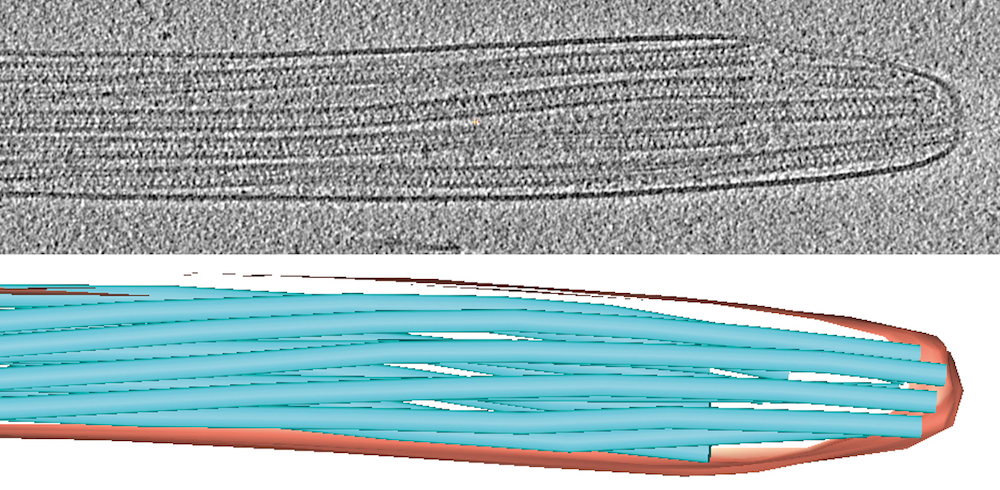
Researchers found the mysterious structure in the sperm tails by using cryo-electron tomography.
" We believe that thisspiral may act as a corkinside the microtubule , preventing them from growing and shrinking as they would normally do , and instead allowing the sperm ’s energy to be to the full focalize on swimming rapidly towards the orchis , " Zabeo sound out in the argument .
Despite the surprisal surrounding this determination , it ’s not the only recent sperm uncovering . Just last year , researchers found that human spermatozoan cells get an special oomph when they float , largely because of complect elastic springs in their tail that communicate with other regions of the bum , Live Science antecedently reported .
The new subject area was put out online Feb. 9 in thejournal Scientific Reports .

Original clause onLive scientific discipline .