Archaeologists found evidence that the remains from Portugal’s Sado Valley were mummified before burial, making them the oldest mummies in the world by about 1,000 years.
Peyroteo - Stjerna et al / European Journal of ArchaeologyAn example show how ancient multitude in Portugal may have mummify human remains .
When Portuguese archaeologist Manuel Farinha arrange Santos die out in 2001 , he left behind a hardening of photo he ’d direct during an mining of the Sado Valley in the sixties . Now , researchers say that these rediscovered photographs render the oldest known mama ever find .
In a study put out in theEuropean Journal of Archaeology , researchers make the case that the Sado Valley remains , which are around 8,000 years old , bear clear marks of mumification necrosis .
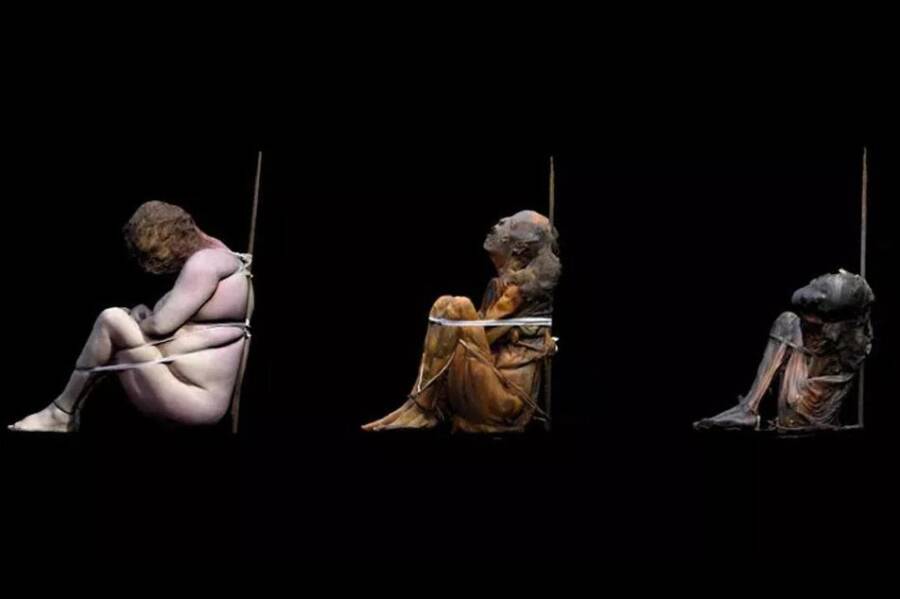
Peyroteo-Stjerna et al/European Journal of ArchaeologyAn illustration showing how ancient people in Portugal may have mummified human remains.
“ Some bodies may have been mummify prior to burial , a phenomenon possibly connect to their curation and transport , spotlight the significance of both the consistency and the burial place in Mesolithic south - westerly Portugal , ” the generator write in their study .
The archeologist looked at a routine of factors to make this determination . They used a method called archaeothanatology to psychoanalyse the 13 cadaver , and compared the skeleton to putrefaction experiments behave by the Forensic Anthropology Research Facility at Texas State University .
First of all , they notice thatthe clappers of one skeletonwere “ hyperflexed ” — or move behind their natural stead . This indicate that they were tied into place with bind that have since disintegrate .
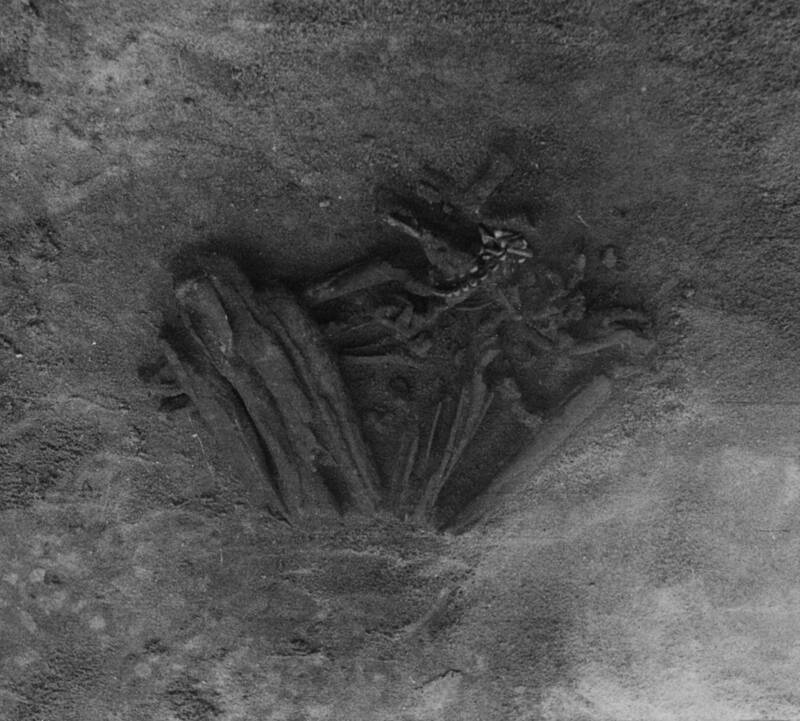
Poças de S. BentoOne of the Sado Valley remains, photographed in 1960 during excavation.
Secondly , the pearl of this skeleton were still firmly in place — that is , they had not disarticulate . This indicate that the body was buried as a mummy and not as a fresh clay , proceed those bones in place .
And , in the end , the soil around the grave accent appeared for the most part intact . If the body was buried without mummification , its soft tissue would have decompose , creating voids that would be filled by deposit . Since this filth seemed intact , it paint a picture that the body did not decompose — and therefore was already a mummy when it was buried .
Poças de S. BentoOne of the Sado Valley stay , photograph in 1960 during digging .

Uppsala University and Linnaeus University in Sweden and University of Lisbon in PortugalThis depiction shows how a fresh cadaver would impact the soil around it, versus a desiccated, or dried out, one.
base on the decomposition experiments convey at the Forensic Anthropology Research Facility at Texas State University , the researchers theorized that ancient citizenry had a methodological way of preparing their mommy . They belike tie up them , congeal them on an elevated weapons platform to drain their fluids , and used firing to dry out out the corpses .
Why go through these steps at all ? In their study , archeologist hypothesized that ancient people dry up remains to make them easy to impart , possibly to purposely inhume them at a substantial internet site .
“ In this slip , the pre - burial treatment would allow for the consistency to be curated for some time and ease its transport ( being more sign on and significantly light than the brisk cadaver ) while ensuring that it was buried while retaining its anatomical integrity , ” the authors wrote .
“ These praxis would also underscore the significance of the burial places and the importance of bring the dead to these location in a style that incorporate and protected the physical structure , following principle that were culturally regulated . ”
If the archaeologists are correct in their assumptions , then the Sado Valley mummies , at 8,000 days older , would be the oldest ever found . Thepreviously oldest mummy , found in Chile ’s Atacama Desert , is 1,000 years younger than the Lusitanian I .
The oldest Egyptian mummies know to be engagement from about 4,000 years ago , although there is evidence to suggest that they began embalming body for mummification as early as 5,700 . The oldest intentional mummy previously ground in Europe engagement to about 1,000 B.C.
Uppsala University and Linnaeus University in Sweden and University of Lisbon in PortugalThis depiction demonstrate how a fresh cadaver would impact the soil around it , versus a desiccate , or dried out , one .
Rita Peyroteo - Stjerna , a bioarchaeologist at Uppsala University in Sweden , and the lead author of the field of study , said that it took a thorough examination of the 1960s picture to notice and document the cold gangrene process .
“ It ’s very hard to make these observations , but it ’s possible with commingle methods and data-based work , ” she told Live Science .
It ’s surely possible that more ancient the great unwashed used cold gangrene to maintain corpse in Europe . But unlike Egypt or Chile , which both famously have mom , surfactant condition in Europe think of that any ancient mummies may not have survived for long .
However , the methods used by Peyroteo - Stjerna and her squad may help identify mummies elsewhere . In this shell , it took finding clues of mummification — and not intact mummies themselves — to name some of the world ’s oldest preserved corpse .
After reading about the humankind ’s oldest mummy ground in Portugal , discover the level of theLlullaillaco Maiden , the Incan child ritual killing mummy . Or , learn the fascinating narration behind mummyKing Tut ’s masquerade .
